Introduction
The Avio® 3000, the latest extension of PerkinElmer’s inductively coupled plasma optical emission spectroscopy (ICP-OES) portfolio, redefines true simultaneous ICP-OES, delivering high speed of analysis and accurate, defensible data—every run, every day—while keeping operational costs under control.
This is due to next-generation technology: the three main sub-systems – the plasma, the optical system, and the detector – have all been redesigned to deliver best-in-class performance without the overhead. This technical note focuses on the technology behind the latest innovation in plasma technology. Similar insights about the other primary system components of the Avio® 3000 ICP-OES can be found elsewhere.1,2 Plasma robustness and stability are essential when performing analyses by ICP-OES. Traditionally, the plasma is generated by passing argon through a series of concentric quartz tubes (the ICP torch) within a helical copper radio frequency (RF) induction coil. Once established, this highly-ionized argon plasma can reach uploaderatures as high as 10,000 K, allowing for complete atomization of the compounds within a sample.
A major breakthrough in plasma formation first occurred on PerkinElmer’s Optima™ 8300 ICP-OES with the incorporation of FlatPlate™ plasma technology, which replaced the copper induction coil with two maintenance-free aluminum plates that did not require cooling, reducing maintenance and consumables.
The Avio® 3000 ICP-OES introduces patented HeliPlate™ plasma technology, the second-generation in flat-plate technology, extending the advantages over traditional helical induction coil designs.
Increased Efficiency and Reliability
Still being maintenance-free, HeliPlate plasma technology works in conjunction with new innovative electronic oscillator circuitry, which is air cooled. This means that the Avio® 3000 runs without the use of a chiller or recirculator, reducing cost, maintenance, heat, noise, weight, and carbon footprint while occupying less lab space, as shown in Table 1. HeliPlate technology produces plasmas with the oscillator running well below its capacity, even at its highest RF power setting, extending oscillator lifetime and reliability while using less electricity and lower argon plasma flows compared to traditional helical coil systems, reducing argon consumption. The combination of lower electricity due to not needing to power a chiller and reduced HVAC requirements, and lower argon consumption reduces both lab costs and environmental impact.
Table 1. Avio® 3000 ICP-OES Benefits for Labs
Figure 1. Photo of HeliPlate plasma technology in the Avio® 3000 ICP-OES.
HeliPlate technology achieves greater plasma robustness and stability because of its unique design: two aluminum plates with altered geometry (Figure 1) which produce a uniquely shaped plasma, resulting in lower argon consumption compared to traditional plasmas, while accommodating all sample introduction systems and flows.
Robust Plasma Handles All Matrices
HeliPlate technology provides excellent power stability when cycling between different matrices. The power difference from the set point is well within 1% (Figure 2) over a 24-hour period when continuously cycling between a variety of difficult matrices: high acids, high salt, air, and water. Although air and water are simple matrices, they affect the plasma very differently than high acids and salts. The fact that plasma power varies by less than 1% when aspirating high acid or salt followed by air or water indicates the consistency of the oscillator when varying matrices. The stability in plasma power results in more consistent atomization, ionization and excitation in the plasma, independent of matrix, increasing analysis stability.
Figure 2. Variation of plasma power readback over 24 hours while cycling through high acids, high salts, water, and air.
To demonstrate plasma stability in a heavy matrix, a 15% NaCl brine was analyzed over 8 hours under default plasma power (Table 2). With analyte variations of less than ±10%, plasma stability is evident, demonstrating plasma robustness at 1100 W.
Table 2. Plasma Conditions Used for 15% NaCl Stability in Figure 3.
Figure 3. Stability in 15% NaCl over 8 hours
Volatile Solvents
Plasma ruggedness is also evident when analyzing volatile organic solvents. As the boiling point of a solvent decreases, the vapor loading of the plasma increases due to solvent evaporation in the spray chamber.
This extra gas is transferred to the plasma and can push the plasma outside of the RF field, causing the plasma to extinguish.
However, HeliPlate technology produces a robust plasma which stays lit even with highly volatile solvents. Figure 4 shows the plasma while aspirating methylene chloride (boiling point = 40 °C) at 1 mL/min without the use of a chilled spray chamber.
Figure 4. Photo of a plasma while aspirating methylene chloride, with a sample uptake rate of 1 mL/min, without a chilled spray chamber.
Another way to check plasma robustness is by running different matrices and monitoring variations in the plasma power with each matrix. An extreme example is cycling between introducing methanol, air, and water into the plasma. As shown in Figure 5, the plasma power varied by less than 1% over 25 hours when cycling between the introduction of methanol, air, water, and air to the plasma. This low power variation, despite the extremely different matrices being introduced to the plasma, emphasizes the robustness of HeliPlate plasma technology.
Figure 5. Variation of plasma power readback over 24 hours, while cycling through methanol, air, and water.
A Maintenance-Free Plasma
Traditional helical induction coils are made of copper and, therefore, tend to oxidize, resulting in wear and eventual replacement. Conversely, the innovative HeliPlate technology is made of high-quality aluminum and has a larger surface area than a helical coil, which dissipates heat. Consequently, the HeliPlate system does not require cooling; even under prolonged operation at maximum power, the HeliPlates look like new, with no sign of aging. No cooling and no degradation of the HeliPlate system means less downtime and expense.
Touchless Ignition
The Avio® 3000 ICP-OES is equipped with touchless ignition. Traditional igniters can be accidentally moved, resulting in failed ignitions, requiring time to troubleshoot the problem. Using a touchless system eliminates these issues, resulting in less downtime and more successful plasma ignitions – greater than 99% success rate with HeliPlate technology. This high ignition rate is achieved without a hole in the torch glass (common in other torch designs), eliminating the possibility of air entrainment which cools the plasma, leading to increased sample matrix-induced effects in the plasma.
Summary
The innovative HeliPlate plasma technology builds on the successful FlatPlate oscillator design, providing the additional advantage of not requiring a chiller, leading to reduced noise, cost, maintenance, environmental impact, and footprint in the lab, while improving plasma robustness and maintaining the advantages of requiring low argon flow, being maintenance-free, and not requiring cooling.
'HeliPlate Plasma Technology on the Avio® 3000 ICP-OES: Maximized Plasma Robustness Without a Chiller'에 관한 궁금한 내용은 본 원고자료를 제공한 퍼킨엘머코리아(유)를 통하여 확인할 수 있다.
Reference(참고문헌):
1.“The Avio® 3000 ICP-OES Optical System: Measuring Low Concentrations with Higher Confidence”, PerkinElmer Technical Note, 2026.
2.“The Avio® 3000 ICP-OES Detector: Boosting Speed and Precision with Next-Generation Technology”, PerkinElmer Technical Note, 2026.
Model Name(모델명): Avio® 3000
The Person in Charge(담당자): Miry Yu
Maker(제조사): PerkinElmer
Country of Origin(원산지): US
e-mail: Miry.yu@perkinelmer.com
Data Services(자료제공): PerkinElmer
<이 기사는 사이언스21 매거진 2026년 5월호에 게재 되었습니다.>
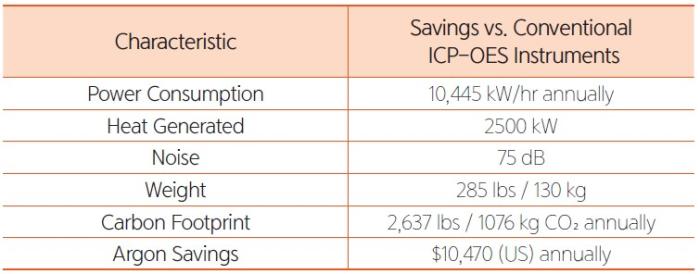
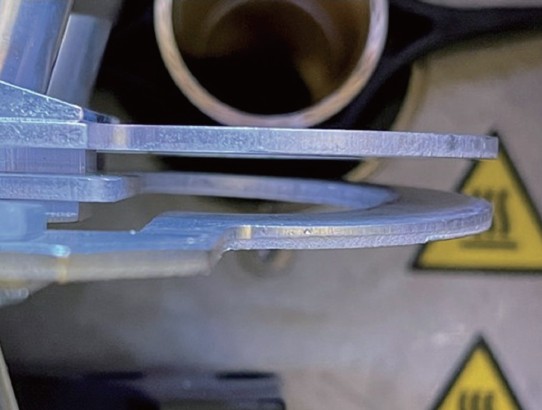 Figure 1. Photo of HeliPlate plasma technology in the Avio® 3000 ICP-OES.HeliPlate technology achieves greater plasma robustness and stability because of its unique design: two aluminum plates with altered geometry (Figure 1) which produce a uniquely shaped plasma, resulting in lower argon consumption compared to traditional plasmas, while accommodating all sample introduction systems and flows.Robust Plasma Handles All MatricesHeliPlate technology provides excellent power stability when cycling between different matrices. The power difference from the set point is well within 1% (Figure 2) over a 24-hour period when continuously cycling between a variety of difficult matrices: high acids, high salt, air, and water. Although air and water are simple matrices, they affect the plasma very differently than high acids and salts. The fact that plasma power varies by less than 1% when aspirating high acid or salt followed by air or water indicates the consistency of the oscillator when varying matrices. The stability in plasma power results in more consistent atomization, ionization and excitation in the plasma, independent of matrix, increasing analysis stability.
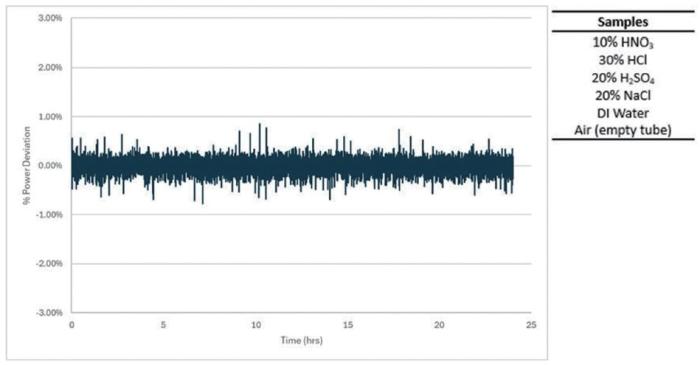 Figure 2. Variation of plasma power readback over 24 hours while cycling through high acids, high salts, water, and air.To demonstrate plasma stability in a heavy matrix, a 15% NaCl brine was analyzed over 8 hours under default plasma power (Table 2). With analyte variations of less than ±10%, plasma stability is evident, demonstrating plasma robustness at 1100 W.Table 2. Plasma Conditions Used for 15% NaCl Stability in Figure 3.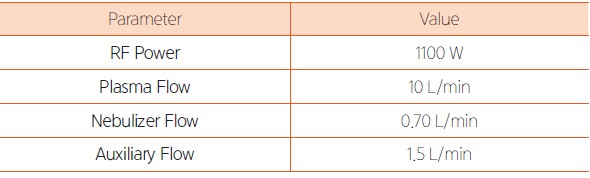
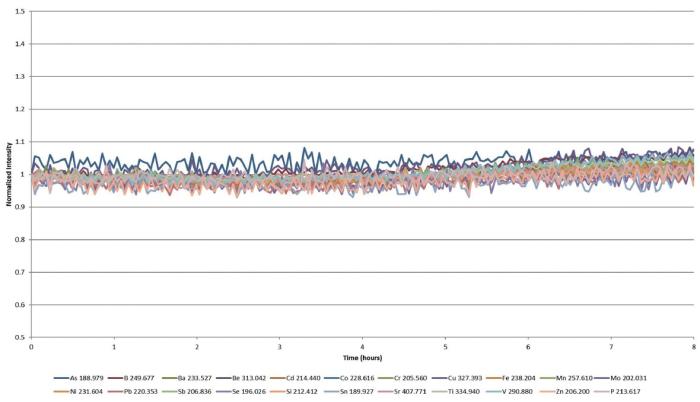 Figure 3. Stability in 15% NaCl over 8 hoursVolatile SolventsPlasma ruggedness is also evident when analyzing volatile organic solvents. As the boiling point of a solvent decreases, the vapor loading of the plasma increases due to solvent evaporation in the spray chamber.This extra gas is transferred to the plasma and can push the plasma outside of the RF field, causing the plasma to extinguish.However, HeliPlate technology produces a robust plasma which stays lit even with highly volatile solvents. Figure 4 shows the plasma while aspirating methylene chloride (boiling point = 40 °C) at 1 mL/min without the use of a chilled spray chamber.
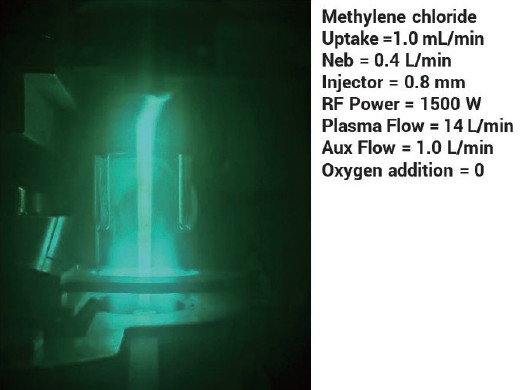 Figure 4. Photo of a plasma while aspirating methylene chloride, with a sample uptake rate of 1 mL/min, without a chilled spray chamber.Another way to check plasma robustness is by running different matrices and monitoring variations in the plasma power with each matrix. An extreme example is cycling between introducing methanol, air, and water into the plasma. As shown in Figure 5, the plasma power varied by less than 1% over 25 hours when cycling between the introduction of methanol, air, water, and air to the plasma. This low power variation, despite the extremely different matrices being introduced to the plasma, emphasizes the robustness of HeliPlate plasma technology.
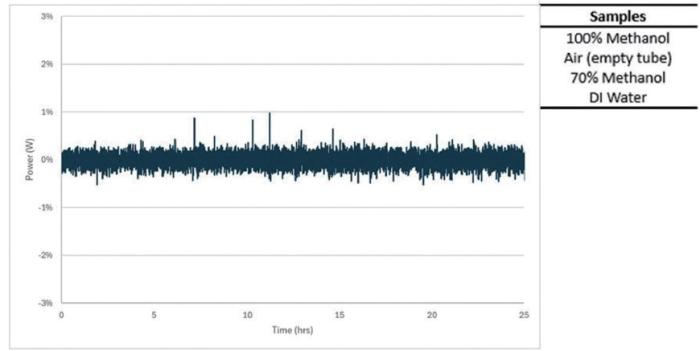 Figure 5. Variation of plasma power readback over 24 hours, while cycling through methanol, air, and water.A Maintenance-Free PlasmaTraditional helical induction coils are made of copper and, therefore, tend to oxidize, resulting in wear and eventual replacement. Conversely, the innovative HeliPlate technology is made of high-quality aluminum and has a larger surface area than a helical coil, which dissipates heat. Consequently, the HeliPlate system does not require cooling; even under prolonged operation at maximum power, the HeliPlates look like new, with no sign of aging. No cooling and no degradation of the HeliPlate system means less downtime and expense.Touchless IgnitionThe Avio® 3000 ICP-OES is equipped with touchless ignition. Traditional igniters can be accidentally moved, resulting in failed ignitions, requiring time to troubleshoot the problem. Using a touchless system eliminates these issues, resulting in less downtime and more successful plasma ignitions – greater than 99% success rate with HeliPlate technology. This high ignition rate is achieved without a hole in the torch glass (common in other torch designs), eliminating the possibility of air entrainment which cools the plasma, leading to increased sample matrix-induced effects in the plasma.SummaryThe innovative HeliPlate plasma technology builds on the successful FlatPlate oscillator design, providing the additional advantage of not requiring a chiller, leading to reduced noise, cost, maintenance, environmental impact, and footprint in the lab, while improving plasma robustness and maintaining the advantages of requiring low argon flow, being maintenance-free, and not requiring cooling.'HeliPlate Plasma Technology on the Avio® 3000 ICP-OES: Maximized Plasma Robustness Without a Chiller'에 관한 궁금한 내용은 본 원고자료를 제공한 퍼킨엘머코리아(유)를 통하여 확인할 수 있다.Reference(참고문헌):